

Most guides tend to list only a few, or no more than ten, common styles.
In this guide from HanYu Jewellery, however, we will list as many styles as possible, whilst also introducing you to the historical origins and cultural significance of each.
Whichever style you prefer, you will find the answer here.
If you would like to commission a bespoke ring, please feel free to contact HanYu Jewelry's customer service team at any time; we will provide you with the most professional assistance.
Ring types fall into four broad camps: relationship rings (promise, wedding, eternity), statement rings (cocktail, armor, dome), symbolic rings (signet, birthstone, knot), and design-defined rings (solitaire, band, filigree). Knowing the category helps you narrow down what you're actually looking for.
Rings That Signal a Relationship
Five ring types exist specifically to tell the world something about your relationship status. Each one carries a different weight - from "I'm interested" to "till death."

Promise Rings
The idea goes back to 16th-century England, where lovers exchanged "posy rings" - bands engraved with short poems in Norman French. The tradition stuck, though the poetry got replaced by simpler gestures. A promise ring today says "I'm committed" without the formal weight of an engagement. No timeline, no obligation to propose next. It just means the relationship is serious.
They're not just for couples, either. Parents give them to children. Friends exchange them. The Catholic Church once used a version called a "chastity ring" for purity pledges. The common thread is a promise - any promise.

Engagement Rings
The first recorded diamond engagement ring was given in 1477 - Archduke Maximilian of Austria to Mary of Burgundy. But diamonds didn't become the default until 1947, when De Beers ran the "A Diamond is Forever" campaign. Before that, rubies and sapphires were just as common.
The "two months' salary" rule? Also De Beers, from the 1980s. There's no tradition behind it - just advertising. What matters is the ring itself and what it represents. Toi et moi settings (two stones side by side) are trending hard in 2026 after celebrity engagement announcements made them visible again.

Wedding Rings
Ancient Romans believed a vein ran directly from the fourth finger of the left hand to the heart - the "vena amoris." The anatomy is wrong, but the tradition survived. In Germany, Russia, and India, the wedding ring goes on the right hand instead. In Sweden, both partners wear engagement rings, not just the bride.
Materials vary by culture too. Platinum and gold dominate in the West. Stainless steel and tungsten are growing - cheaper, more durable, and better suited for people who work with their hands. The ring itself doesn't need to be expensive to mean something.

Eternity Rings
A continuous loop of identical stones around the entire band - no beginning, no end. Ancient Egyptians had a version around 2000 BCE, shaped like a snake swallowing its own tail (the ouroboros). The modern diamond eternity ring didn't become popular until the 1960s, when De Beers promoted it as an anniversary gift.
One practical note: full eternity rings (stones all the way around) can't be resized. If your finger size changes, the ring won't fit. Half-eternity rings - stones only on the top half - are easier to resize and more comfortable to wear daily.

Claddagh Rings
Two hands holding a heart, topped with a crown. The design comes from the fishing village of Claddagh in Galway, Ireland, around the 1700s. Richard Joyce - enslaved in Algeria for years - learned goldsmithing in captivity and forged the first one as a symbol of the love he carried.
How you wear it tells a story. Right hand, heart facing out: single and looking. Right hand, heart facing in: in a relationship. Left hand, heart facing in: married. It's one of the few rings with a built-in social signal that people still follow.
Rings That Demand Attention
These are rings you notice from across a room. Bold by design, not by accident.

Cocktail Rings
The name comes from American Prohibition (1920-1933). Women wore oversized, flashy rings to illegal cocktail parties as a quiet act of rebellion - the ring was a signal that you were drinking, which was technically a crime. The bigger the stone, the bolder the statement.
Cocktail rings are defined by drama. Large gemstones, ornate metalwork, designs that take up most of the finger. They're occasion rings - not something you'd wear while typing or doing dishes. If someone calls it a "dinner ring," that's the same thing.

Dome Rings
A convex, rounded profile that catches light from every angle. Dome rings were a staple of the Art Deco era (1920s-1930s) and cycle back into fashion every decade or so. The curved surface creates a mirror-like reflection that flat rings can't match.
Despite their large appearance, most dome rings sit comfortably. The interior is usually flat or comfort-fit, so the height is all visual. Gold, silver, acrylic, wood - the dome shape works with nearly any material.
Rings That Carry Meaning
Some rings aren't about relationships or fashion. They represent identity, heritage, or personal belief.

Signet Rings
Before signatures existed, your ring WAS your identity. The word "signet" comes from the Latin signum - a sign or mark. Owners pressed the engraved face into hot wax to seal letters and legal documents. Forging someone's signet in medieval England was a capital offense. That's how much legal weight these rings carried.
Today, signet rings are worn for heritage, personal style, or family connection. Some still carry family crests. Others are blank-faced or engraved with initials. Traditionally worn on the pinky finger of the non-dominant hand.

Birthstone Rings
The modern birthstone list was standardized in 1912 by the American National Association of Jewelers. Before that, different cultures assigned different stones to each month - there was no universal list. January's garnet, April's diamond, July's ruby - all marketing decisions that stuck.
What makes birthstone rings interesting is the personal weight. The stone isn't decorative - it's tied to your birth month, your identity, or someone you love. That's why they're one of the most popular gift rings across cultures.

Charm Rings
The concept of wearing charms for protection goes back to ancient Egypt. Small amulets - scarabs, ankhs, eyes of Horus - were attached to rings and worn as talismans against evil. Greek and Roman soldiers wore charm rings before battle. The belief was that specific symbols carried protective power.
Modern charm rings come in two forms: fixed motifs (hearts, stars, celestial symbols molded into the band) and dangling charms (small pendants that hang from the shank, similar to charm bracelets). Both styles let you carry personal symbolism on your finger.
Rings Defined by Their Construction
These ring types are named for how they're built, not what they symbolize.

Solitaire Rings
One stone, center stage. Tiffany & Co. changed solitaire design forever in 1886 when they introduced the six-prong setting that lifts the diamond above the band. Before that, stones sat flush against the metal. The raised mount lets light enter from below, which dramatically increases brilliance.
Solitaire doesn't mean diamond. Sapphires, rubies, emeralds, and even lab-grown moissanite work in the format. The defining feature is a single stone - no accents, no halos, nothing competing for attention.

Band Rings
The oldest ring form in existence. Earliest known examples date to the Neolithic period - over 5,000 years ago. A band is just a continuous loop of material with no stone, no engraving, no embellishment. Flat, concave, convex, hammered, brushed, polished - the variations are all in the finish and profile.
Still the most popular ring style globally. Wedding bands are the most common example, but plenty of people wear bands with zero romantic intent. A wide silver band on the index finger is one of the cleanest looks in men's ring styling.

Cluster Rings
Multiple smaller stones grouped tightly together to create the visual impact of a single large stone. Cluster rings gained popularity in the Georgian era (1714-1837) as a cost-effective alternative to large solitaires. The same carat weight spread across several stones costs significantly less than one stone of that size.
Common arrangements: flower shapes, starburst patterns, and asymmetric scatters. Mixed-stone clusters - diamonds paired with colored gems - are a Victorian specialty that's coming back in modern designs.

Disconnected (Open) Rings
A deliberate gap in the band. The opening can be at the front (decorative) or at the back (adjustable). The visual tension of an incomplete circle is the whole point - it draws the eye exactly because something is "missing."
Open-front designs trace back to ancient Celtic knotwork, where negative space was as important as the material itself. Modern versions use the gap for gemstone placement - two stones facing each other across the opening, creating a "toi et moi" effect without a traditional setting.
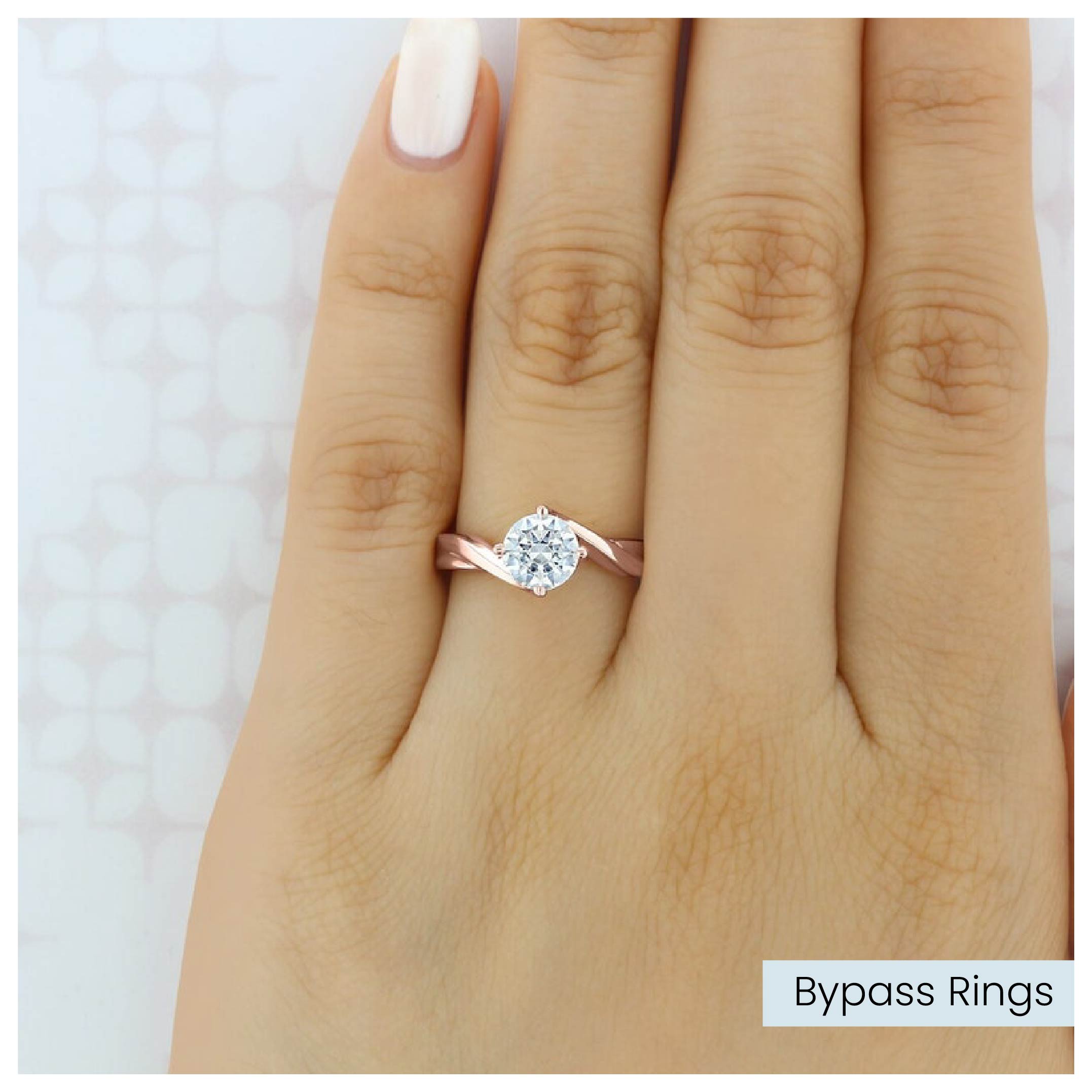
Bypass Rings
The band wraps around the finger and the two ends pass each other without meeting. Snake rings - where a serpent's head meets its own tail - are the most iconic bypass design and date back to ancient Greece. Cleopatra reportedly wore gold snake rings as symbols of eternal rule.
Leaf, vine, and floral bypass rings are popular in modern fashion. The asymmetric design looks more dynamic than a closed band - and gemstones placed at either end create two focal points instead of one.
Frequently Asked Questions About Ring Types
What is the difference between a promise ring and an engagement ring?
A promise ring signals commitment without a marriage proposal. The timeline stays open. An engagement ring is a direct proposal with a wedding date in mind. Promise rings tend to be simpler in design, while engagement rings usually feature a prominent center stone.
Which types of rings work best for everyday wear?
Band rings, signet rings, and dome rings. They sit low on the finger and don't snag on things. Stainless steel and sterling silver handle daily wear better than softer metals like brass or gold. Cocktail and cluster rings are better saved for events.
What are the most popular ring types for men?
Signet rings, band rings, and statement rings. Signet rings carry heritage. Band rings keep things minimal. Statement rings - skull designs, armor rings, gemstone pieces - express personality. Men's engagement rings are also growing, with sales up over 200% since 2022.
Can you stack different types of rings on one hand?
Yes. One bold ring per hand (statement or cocktail), then fill in with thinner bands or knot rings. Mixing metals works if it's intentional. Space rings across fingers rather than stacking three on one. Our ring stacking guide has specific combinations.
How do I choose the right ring type for my personal style?
Start with function. If you work with your hands, stick to bands or signet rings. If you dress up often, cocktail or cluster rings add the right attention. For personal meaning, go with a birthstone, Claddagh, or knot ring. For more details, feel free to contact us.


