

Gold Recycling Guide: How Old Jewellery Becomes New Again
Meta Description: Discover the secrets of gold recycling! This guide explores how old jewellery transforms into new treasures, the environmental benefits of recycled gold, and how the Singapore gold market gives your unused pieces a second life.
Why Your Old Jewellery is More Than Just a Memory-It's a Future Treasure
Every year, millions of dollars worth of gold jewellery sits forgotten in drawers across Singapore-broken chains, outdated designs from decades past, and single earrings. While these pieces may seem like they have lost their purpose, in the world of Gold Recycling, they hold incredible potential.
Gold is not just a precious metal; it is a renewable resource. This guide will take you deep into the process of how old jewellery is transformed into brand-new treasures and why choosing recycled gold is both an environmentally friendly and financially smart decision.

The Science Behind Gold Recycling: The Eternal Metal
Gold's Molecular Indestructibility
Gold is the perfect candidate for recycling because it is virtually indestructible at the molecular level. Unlike paper that degrades or iron that rusts, gold maintains its fundamental properties forever. A gold artifact from ancient civilizations contains the exact same gold atoms that could become a modern piece of Singapore Jewellery tomorrow.
This permanence stems from gold's status as a "noble metal":
Resistance to Oxidation & Corrosion: Whether buried for centuries or melted hundreds of times, its essence remains unchanged.
Ideal Melting Point: At 1,064°C, gold melts at a temperature high enough to separate impurities but low enough for practical processing.
Chemical Inertness: It doesn't react with most chemicals, ensuring purity is preserved after refining.
This means that Recycled Gold retains 100% of its original value and quality-a feat few other materials can claim.
Comprehensive Guide: The 5 Steps of Gold Recycling
Curious how your old gold necklace becomes a pristine gold bar or a new ring? The professional gold recycling process typically involves these five stages:
1. Collection and Initial Assessment
Sources include personal unused jewellery (broken, outdated styles), industrial scraps (electronic waste), and investment gold bars.
2. Testing and Sorting
This is the critical step to ensure value. Professional recyclers use various technologies:
X-Ray Fluorescence (XRF): Non-destructive analysis to precisely measure gold content.
Acid Testing: A traditional and quick method for verifying purity.
Fire Assay: The most accurate method involving melting and cupellation.
Purity Sorting: Categorizing gold into 999 (24K), 916 (22K), 750 (18K), etc.
3. Preparation
Before melting, non-gold components like gemstones, clasps, and mechanisms must be mechanically removed, and the gold is cleaned of oils and dirt.
4. Melting and Refining
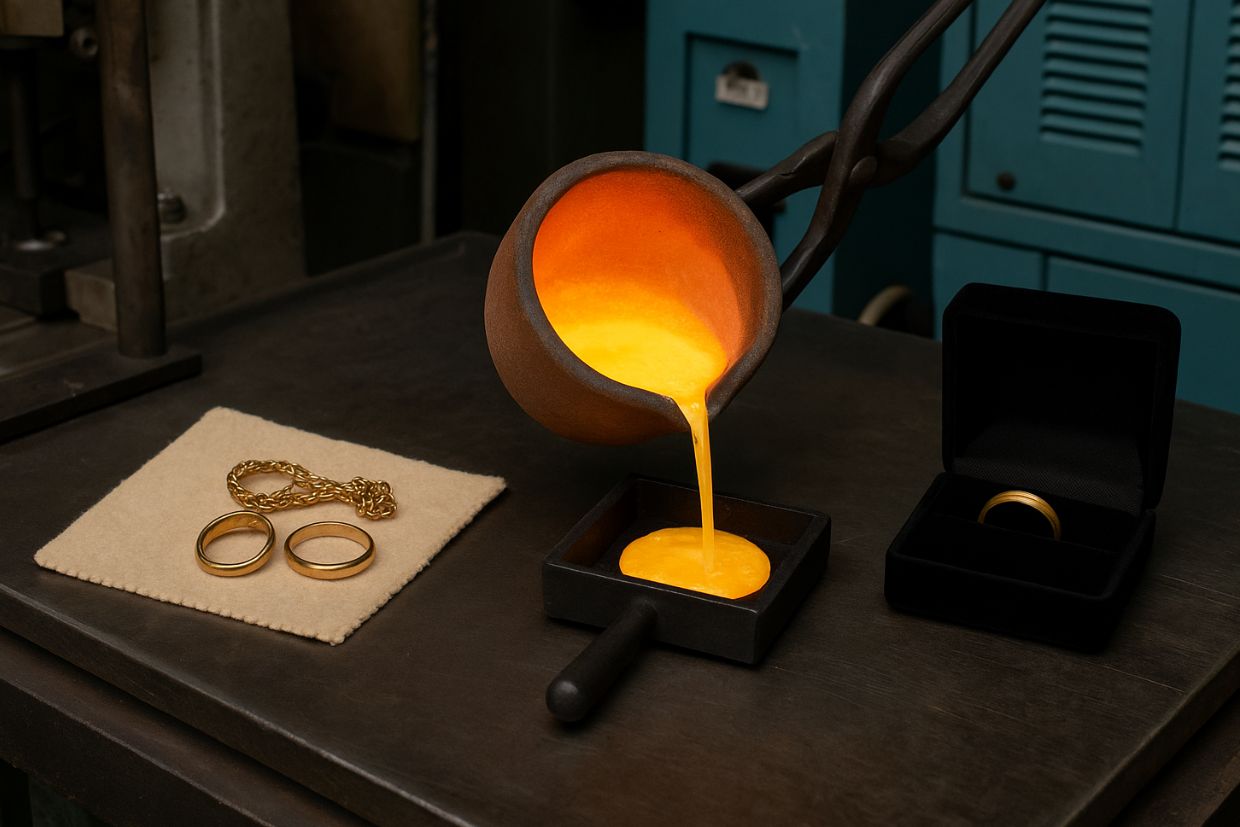
The gold is heated to a liquid state. Chemical refining processes (such as the Aqua Regia or Miller process) are used to strip away all impurities/alloys, eventually isolating pure gold that can reach 99.9% or even 99.99% purity.
5. Reformation
The purified gold is cast into new forms-gold bars, coins, or manufacturing grain (gold shot)-ready to be crafted into the next masterpiece.
Environmental & Sustainability: Why Choose Recycled Gold?
In an era where Sustainability is paramount, gold recycling is not just an economic act; it's an environmental statement.
Recycling vs. Mining: A Stark Contrast
Traditional gold mining has a massive environmental impact, making recycling a green alternative:
Reduced Carbon Footprint: The carbon emissions of recycling gold are negligible compared to mining.
Water Conservation: Mining one kilogram of gold can consume 140,000 liters of water; recycling requires only a fraction for cooling.
Ecosystem Protection: Recycling avoids land displacement and the use of toxic chemicals like cyanide and mercury often associated with mining.
Choosing Sustainable Jewellery made from recycled gold means directly participating in the circular economy and protecting our planet's resources.

Gold Recycling in Singapore: A Cultural Perspective
As a multicultural hub for gold trading, Singapore has unique perspectives on gold recycling:
Chinese Community: Often balances preserving heirlooms with the practicality of recycling for liquidity or new designs.
Indian Community: Frequently recycles old gold to "upgrade" jewellery for weddings and festivals, keeping their assets current.
Malay Community: Tends to recycle selectively, preserving pieces with high religious or cultural significance.
Whether to keep up with fashion trends or to capitalize on high gold prices, Singapore's mature recycling market (including jewellers, pawnshops, and refineries) offers transparent and convenient channels for consumers.
What Can Be Recycled?
Not everything that glitters is recyclable gold. Here is a checklist for high-value recycling:
✅ Suitable for Recycling:
Gold Chains & Necklaces: Usually have high gold content.
Rings & Bangles: Especially solid Asian-style gold bangles (916/999 gold).
Single Earrings: The best solution for a piece that has lost its match.
Gold Watch Cases: Older luxury watches often have substantial gold weight in the case and bracelet.
❌ Generally Not Suitable:
Gold-Plated Items: The gold layer is too thin to be economically extracted.
Costume Jewellery: Often contains no precious metals.
Antiques: Historical artifacts often hold more value intact than as melted metal.
Conclusion: Let the Story Continue
The gold in your jewellery box may have traveled through the stars billions of years ago and undergone countless transformations. By participating in Gold Recycling, you are not only unlocking its economic value but also continuing its story while protecting our planet.
HanYu Jewellery is committed to promoting gold knowledge and sustainable fashion. If you have unused old gold jewellery, now is the perfect time to give it a "new life."
Keywords: #GoldRecycling #SustainableFashion #CashForGold #EcoFriendlyLuxury


