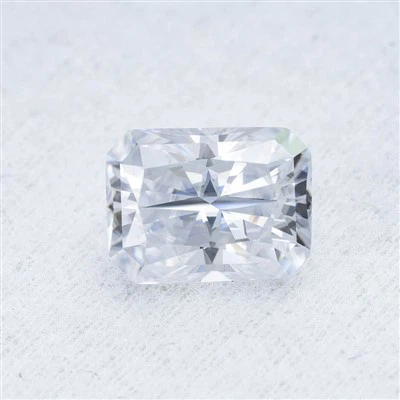
In the world of gemstones, diamonds have long held a position of unparalleled allure. Their brilliance, durability, and cultural significance have made them a symbol of luxury and love. However, a relatively new entrant to the market, the oval moissanite diamond, has been gaining popularity, offering an alternative that combines beauty with affordability. As a supplier of oval moissanite diamonds, I am often asked about the differences between these two gemstones. In this blog post, I will delve into the various aspects that set oval moissanite diamonds apart from natural diamonds.
Composition and Origin
The most fundamental difference between oval moissanite diamonds and natural diamonds lies in their composition and origin. Natural diamonds are formed deep within the Earth's mantle under extreme heat and pressure over billions of years. They are composed of pure carbon atoms arranged in a crystal lattice structure, which gives them their unique physical and optical properties.
On the other hand, moissanite is a silicon carbide (SiC) mineral. It was first discovered in 1893 by Henri Moissan in a meteorite crater in Arizona. Initially, it was thought to be diamonds due to their similar appearance. However, it was later identified as a new mineral. Today, most moissanite used in jewelry is lab - grown. The process involves creating the right conditions of temperature and pressure to form silicon carbide crystals, which are then cut and polished into various shapes, including the oval cut.
Physical Properties
Hardness
Hardness is a crucial factor when it comes to gemstones, as it determines their resistance to scratching and wear. Natural diamonds are the hardest known substance on Earth, scoring a perfect 10 on the Mohs scale of hardness. This makes them extremely durable and suitable for everyday wear, even in settings that are prone to abrasion.
Moissanite, while still very hard, has a hardness of 9.25 on the Mohs scale. This means that it is highly resistant to scratching but can be scratched by a diamond. In most real - world scenarios, moissanite is durable enough for regular jewelry use, but it may not be as scratch - resistant as a natural diamond over the long term.
Refractive Index
The refractive index of a gemstone determines how much it bends and reflects light, which in turn affects its brilliance and fire. Natural diamonds have a refractive index of approximately 2.42. This high refractive index gives diamonds their characteristic sparkle and makes them appear to glow from within.
Moissanite has an even higher refractive index, around 2.65 - 2.69. This results in more dispersion of light, which means that moissanite can exhibit more fire, or the rainbow - like flashes of color, than a natural diamond. Some people prefer the more intense fire of moissanite, while others appreciate the classic, understated sparkle of a diamond.
Specific Gravity
Specific gravity is the ratio of the density of a substance to the density of water. Natural diamonds have a specific gravity of about 3.52. Moissanite has a lower specific gravity, around 3.22. This difference means that for the same carat weight, a moissanite stone will be slightly larger in size than a diamond.
Appearance
Color
Natural diamonds come in a wide range of colors, from completely colorless to various shades of yellow, brown, and even rare colors like blue, pink, and green. The Gemological Institute of America (GIA) grades colorless diamonds on a scale from D (colorless) to Z (light yellow or brown). The most valuable diamonds are those that are completely colorless (D - F).
Moissanite also comes in different color grades, but it is typically more colorless than most mined diamonds. Most high - quality moissanite on the market today is near - colorless, with a slight yellow or green tint in some cases. However, advancements in lab - growing technology have made it possible to produce moissanite that is very close to being completely colorless.
Inclusions
Inclusions are internal flaws or impurities in a gemstone. Natural diamonds often contain inclusions, which are formed during their long formation process. These inclusions can range from tiny crystals to fractures and can affect the diamond's clarity. The GIA grades diamond clarity on a scale from Flawless (no inclusions visible under 10x magnification) to Included (inclusions visible to the naked eye).
Moissanite, being lab - grown, generally has fewer inclusions compared to natural diamonds. The controlled environment in which it is grown allows for a more uniform crystal structure, resulting in a gemstone that is often clearer and more visually appealing.
Cost
One of the most significant differences between oval moissanite diamonds and natural diamonds is the cost. Natural diamonds are expensive due to their rarity, the high cost of mining, and the complex process of sorting, grading, and marketing. The price of a natural diamond can vary greatly depending on its 4Cs (carat, cut, color, and clarity), with high - quality, large diamonds costing tens of thousands or even hundreds of thousands of dollars.
Moissanite, on the other hand, is much more affordable. Since it is lab - grown, the production cost is lower, and there are no mining - related expenses. As a result, an oval moissanite diamond of similar size and quality to a natural diamond can cost a fraction of the price. This makes moissanite an attractive option for those who want a beautiful, sparkly gemstone without breaking the bank.
Ethical and Environmental Considerations
The mining of natural diamonds has been associated with a number of ethical and environmental issues. In some regions, diamond mining has been linked to human rights abuses, including child labor and conflict financing. Additionally, diamond mining can have a significant environmental impact, including deforestation, soil erosion, and water pollution.
Lab - grown moissanite is a more ethical and environmentally friendly alternative. Since it is created in a laboratory, there is no need for large - scale mining operations. This reduces the environmental impact and ensures that the gemstone is produced under ethical working conditions.
Market Availability
Natural diamonds are widely available in the market, with a well - established supply chain. They can be found in jewelry stores, online retailers, and auction houses around the world. However, the availability of high - quality, large - carat diamonds can be limited, and they may require a significant investment.


As a supplier of oval moissanite diamonds, I can attest to the growing market availability of moissanite. There is a wide range of oval moissanite diamonds available in different sizes, colors, and qualities. In addition to oval cuts, other fancy cuts such as Heart Moissanite Diamond, Trillion Moissanite Diamond, and Asscher Moissanite Diamond are also becoming increasingly popular.
Conclusion
In conclusion, oval moissanite diamonds and natural diamonds have several differences in terms of composition, physical properties, appearance, cost, ethical and environmental considerations, and market availability. While natural diamonds have a long - standing reputation and are highly valued for their rarity and durability, oval moissanite diamonds offer a more affordable, ethical, and environmentally friendly alternative with their own unique beauty.
If you are in the market for a gemstone and are considering an oval moissanite diamond or a natural diamond, I encourage you to weigh the pros and cons carefully. Whether you are looking for a classic diamond engagement ring or a more affordable yet equally beautiful alternative, I am here to help. As a supplier of oval moissanite diamonds, I can provide you with high - quality stones and expert advice. Feel free to contact me for more information or to discuss your specific needs and preferences. Let's start a conversation about finding the perfect gemstone for you.
References
- "Gem Identification: An Introduction" by Richard T. Liddicoat and Robert M. King.
- Gemological Institute of America (GIA) publications on diamond grading and gemstone properties.
- Research papers on moissanite production and properties from scientific journals.