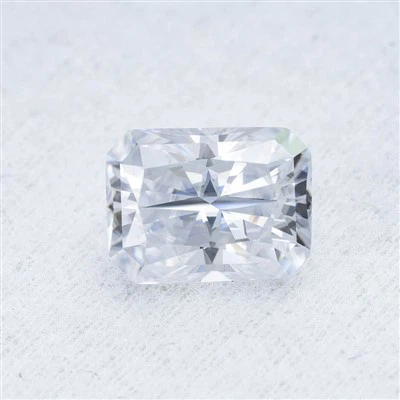
Yo, what's up, everyone! I'm a supplier of Asscher Moissanite Diamond, and today I wanna chat with you about the fluorescence of Asscher Moissanite Diamond.
First off, let's talk a bit about what Asscher Moissanite Diamond is. Asscher Moissanite is a type of fancy - cut moissanite. If you're interested in other fancy - cut moissanites, you can check out Pear Moissanite Diamond and Cushion Moissanite Diamond. But for now, we're focused on the Asscher cut. It has a distinct square shape with cropped corners, which gives it a very elegant and unique look.
Now, let's get into the main topic: fluorescence. Fluorescence in gemstones, including Asscher Moissanite Diamond, is the phenomenon where the stone emits visible light when it's exposed to ultraviolet (UV) light. You know, like those black lights at a party that make some things glow? It's a bit like that, but in the world of gemstones.
There are different levels of fluorescence in Asscher Moissanite Diamond. You've got none, faint, medium, strong, and very strong. When there's no fluorescence, the stone doesn't show any visible glow under UV light. Faint fluorescence might give off a very subtle glow that's hard to notice unless you're really looking for it. Medium fluorescence is more noticeable, and you can clearly see the stone glowing. Strong and very strong fluorescence result in a pretty intense glow.
The color of the fluorescence can vary too. Most commonly, you'll see blue fluorescence in Asscher Moissanite Diamond. But sometimes, you might also come across other colors like yellow, green, or even pink. The color of the fluorescence is mainly determined by the trace elements present in the moissanite.
So, how does fluorescence affect the appearance of Asscher Moissanite Diamond? Well, in normal, everyday lighting conditions, fluorescence usually doesn't have a huge impact. The stone looks just like any other non - fluorescent Asscher Moissanite Diamond. But in certain lighting, especially under direct sunlight or in a place with a lot of UV light, the fluorescence can change how the stone looks.
A lot of people wonder if fluorescence is a good or a bad thing. Well, it really depends on personal preference. Some people actually like the glow that fluorescence gives. They think it adds an extra bit of charm and uniqueness to the stone. It can make the Asscher Moissanite Diamond stand out even more, especially in a setting where there's some UV light around.


On the other hand, some folks aren't too keen on fluorescence. In some cases, very strong fluorescence can make the stone look a bit milky or hazy under certain lighting conditions. This might not be ideal if you're going for that super - clear, sparkly look. But it's important to note that this milky or hazy effect is more likely to happen with very strong fluorescence, and it's not a common occurrence with faint or medium fluorescence.
When it comes to the value of Asscher Moissanite Diamond, fluorescence can also play a role. In general, stones with no fluorescence or faint fluorescence tend to be more popular in the market, and they might have a slightly higher value. That's because they're seen as having a more "pure" look in all lighting conditions. But if you find a stone with a unique color of fluorescence or if you really like the glow, then a stone with stronger fluorescence could be just as valuable to you, even if it's not as popular in the mainstream market.
Another thing to consider is that fluorescence can be a bit of a double - edged sword when it comes to the overall appearance of the setting. If you're planning to set your Asscher Moissanite Diamond in a piece of jewelry, say a ring or a pendant, the fluorescence might interact with the metal and other gemstones in the setting. For example, if you have a white gold setting and a strongly fluorescent blue Asscher Moissanite Diamond, the blue glow might enhance the cool tone of the white gold and make the whole piece look even more stunning. But if the setting has warm - toned metals like yellow gold, the blue fluorescence might clash a bit with the warm color of the metal.
Now, as a supplier of Asscher Moissanite Diamond, I've seen all kinds of stones with different levels of fluorescence. And let me tell you, each one has its own charm. Whether you're into the subtle look of a non - fluorescent stone or you're a fan of the eye - catching glow of a fluorescent one, there's an Asscher Moissanite Diamond out there for you.
If you're in the market for an Asscher Moissanite Diamond, I'd recommend checking out the fluorescence level. You can usually find this information in the gemstone's certificate. And if you have the chance, see the stone under different lighting conditions, including UV light, to get a better idea of how the fluorescence affects its appearance.
At the end of the day, choosing an Asscher Moissanite Diamond with the right fluorescence is all about what you like. There's no one - size - fits - all answer. It's your personal style and preference that should guide your decision.
If you're interested in purchasing Asscher Moissanite Diamond, I'd love to have a chat with you. We can discuss your needs, preferences, and I can show you the different options we have available. Whether you're looking for a stone with no fluorescence, a faint glow, or something with a more intense fluorescence, we've got you covered. Just reach out, and we can start the conversation about finding the perfect Asscher Moissanite Diamond for you.
References:
- Gemological Institute of America (GIA) research on gemstone fluorescence
- Industry reports on moissanite characteristics and market trends