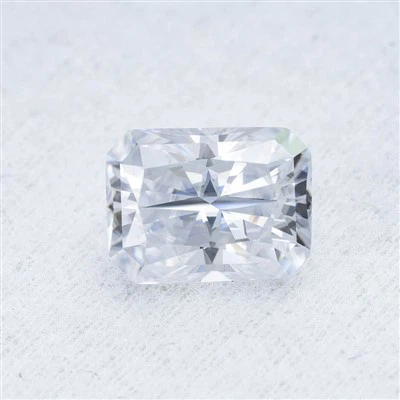
Is Asscher Moissanite Diamond real?
As a supplier of Asscher Moissanite Diamonds, I often encounter the question: "Is Asscher Moissanite Diamond real?" This is a valid and common query, especially in a market where the allure of diamonds remains strong, and new alternatives are constantly emerging. In this blog post, I aim to provide a comprehensive and scientific answer to this question.
Understanding Moissanite
First, let's start with the basics of moissanite. Moissanite is a naturally occurring mineral, but it is extremely rare in nature. It was first discovered by Henri Moissan in 1893 in a meteor crater in Arizona. The mineral he found was silicon carbide (SiC). Initially, it was misidentified as diamonds due to its similar appearance under certain conditions.


Today, most moissanite used in the jewelry industry is lab - created. Through advanced technological processes, scientists can replicate the chemical and physical properties of natural moissanite in a laboratory setting. Lab - created moissanite has several advantages. It is more accessible, and the quality can be more precisely controlled compared to its natural counterpart.
What is an Asscher Moissanite Diamond?
An Asscher Moissanite Diamond refers to moissanite that is cut in the Asscher cut. The Asscher cut is a type of diamond cut that was developed by Joseph Asscher in 1902. It is a square - shaped cut with cropped corners, featuring a high crown and a large table. This cut is known for its art - deco style and its ability to show off the stone's brilliance and fire.
When we say "Asscher Moissanite Diamond," it is important to note that it is not a diamond in the traditional sense. A diamond is composed of pure carbon atoms arranged in a crystal lattice structure. In contrast, moissanite is made of silicon carbide. However, the term "diamond" in this context is often used for marketing purposes to describe the cut style rather than the actual composition of the stone.
Comparing Asscher Moissanite Diamond with Real Diamonds
Physical and Chemical Properties
- Hardness: Diamonds are the hardest known natural material, scoring a 10 on the Mohs scale of hardness. Asscher Moissanite Diamonds, on the other hand, have a hardness of around 9.25 on the Mohs scale. While moissanite is very hard and suitable for everyday wear, it is slightly less scratch - resistant than diamonds.
- Refractive Index: The refractive index measures how much a material can bend light. Diamonds have a refractive index of about 2.42, while moissanite has a refractive index of 2.65 - 2.69. This means that moissanite can disperse light more effectively, resulting in more fire (the dispersion of white light into spectral colors) compared to diamonds.
- Color: Natural diamonds can come in a range of colors, from colorless to various shades of yellow, brown, and even rare fancy colors like blue and pink. Asscher Moissanite Diamonds are typically near - colorless to colorless, and they can closely mimic the appearance of high - quality, colorless diamonds.
Appearance
In terms of appearance, Asscher Moissanite Diamonds can be very difficult to distinguish from real diamonds, especially to the untrained eye. The Asscher cut enhances the stone's brilliance and gives it a sophisticated look. However, with the use of a jeweler's loupe or other specialized equipment, an experienced gemologist can tell the difference between the two. Moissanite often shows a double - refraction effect, which means that light passing through the stone is split into two rays, creating a slightly blurry appearance of the internal facets when viewed under magnification.
The Reality of Asscher Moissanite Diamond
So, is Asscher Moissanite Diamond real? In the sense that it is a real, genuine gemstone, the answer is yes. It is a real piece of moissanite that has been carefully cut and polished into the Asscher cut. It has its own unique properties and beauty.
However, it is not a real diamond in the strictest geological and chemical sense. It is important for consumers to understand this distinction when making a purchase. Many people choose Asscher Moissanite Diamonds as an alternative to diamonds for various reasons. They are often more affordable, and they offer a similar level of beauty and sparkle.
Other Fancy - Cut Moissanite Options
If you are interested in moissanite, there are other fancy - cut options available besides the Asscher cut. For example, the Trillion Moissanite Diamond has a triangular shape, which is very trendy and can add a modern touch to jewelry. The Oval Moissanite Diamond is another popular choice. It has an elongated shape that can make fingers look slimmer and is known for its classic and elegant appearance.
Why Choose Asscher Moissanite Diamond as a Supplier?
As a supplier of Asscher Moissanite Diamonds, I can offer high - quality stones at competitive prices. We have a strict quality control process in place to ensure that each Asscher Moissanite Diamond meets our standards. Our stones are sourced from reliable manufacturers who use advanced technology to create moissanite with excellent clarity and color.
We also offer a wide range of sizes and qualities to meet the diverse needs of our customers. Whether you are a jewelry designer looking for unique stones for your creations or an individual looking to purchase a special piece of jewelry, we can provide the right Asscher Moissanite Diamond for you.
Contact for Purchase and Negotiation
If you are interested in purchasing Asscher Moissanite Diamonds or would like to discuss your specific requirements, please feel free to contact us. We are more than happy to have in - depth discussions about the products, prices, and any other details you may be concerned about. Our team of experts is ready to assist you in finding the perfect Asscher Moissanite Diamond for your needs.
References
- "Gemstones of the World" by Walter Schumann
- "The Diamond Book" by Martin Rapaport